(Quasi-)Harmonic Approximation
Overview
Quantas allows calculating thermodynamic and some thermoelastic properties of materials by means of both harmonic and quasi-harmonic approximations. In the following, the theory behind these approaches are briefly explained.
- Last update
Jul 25, 2024
- Author
Gianfranco Ulian
In standard quantum mechanical methods, temperature-related properties can be modeled by explicitly treating the lattice dynamics. The most adopted approach in this framework is given by the harmonic approximation (HA) of the lattice potential. HA is very effective in predicting vibration properties (for example, Infrared and Raman spectroscopic features) of several materials, from molecules to bulk solids, particularly so when very light atoms are not involved.
However, there is a great drawback in solving the the lattice dynamics of a crystal by the sole harmonic approximation: the vibration frequencies are independent of interatomic distances and, consequently, the vibrational contribution to the internal energy of the material results as independent of volume.
It immediately follows that, within HA, a several physical properties would be wrongly described, or even not described at all: thermal expansion would be zero, isobaric and isochoric heat capacities (specific heats) would not differ, elastic constants would not depend on temperature, thermal conductivity would be infinite, and so on.
A simple, yet powerful approach to overcome the above cited issues is given by the so-called Quasi-Harmonic Approximation (QHA), which introduces the missing volume dependence of phonon frequencies by retaining the harmonic expression for the Helmholtz free energy. The QHA approach allows also the combination of temperature and pressure effects.
In the next sections, a detailed description of the HA and QHA approaches are provided.
Harmonic Approximation
In quantum mechanical simulations of periodic three-dimensional systems (crystals), the harmonic thermodynamic properties of any system under investigation can be obtained by knowing all its vibrational modes in the first Brillouin zone (FBZ), namely at \(\Gamma\) point. The Born-Oppenheimer potential energy surface \(E(\boldsymbol{x})\) of a system is a function of the position \(\boldsymbol{x}\) of the \(N\) nuclei. For a finite system, at the equilibrium nuclear configuration and within the harmonic approximation, \(V(\boldsymbol{x})\) takes the form:
where the \(i\), \(j\) summations run over all the \(3N\) coordinates; \(u_i\) represents a displacement of the \(i\)-th Cartesian coordinate from its equilibrium value; \(H_{ij}\) is the \((i, j)\) element of the matrix of the second derivatives of the potential, evaluated at equilibrium, with respect to the displacement coordinates:
In periodic systems and within the harmonic approximation, phonon frequencies are then evaluated as the eigenvalues of the weighted Hessian matrix \(W\) at \(\Gamma\) point \((k = 0)\), whose \((i, j)\) element is defined as
where \(M_i\) and \(M_j\) are the masses of the atoms associated with the \(i\) and \(j\) coordinates, respectively. \(H_{ij}^{0G}\) is the second derivative of the electronic and nuclear repulsion energy \(E(\boldsymbol{x})\) evaluated at equilibrium \(\boldsymbol{u} = 0\) with respect to the displacement of atom A in cell 0 \((u_i = x_i-x_i^*)\) and displacement of atom B in cell G \((u_j=x_j-x_j^*)\) from their equilibrium position \(x_i^*\), \(x_j^*\):
How energy first and second derivatives are obtained depend on the quantum mechanical code used by the researcher. For example, they could be computed numerically using a “two-point” formula or a “three-point” formula.
At \(\Gamma\) point there are \(3N\) phonon modes, each one associated to an energy level given by the harmonic expression
with \(m\) an integer number and \(\nu_i\) the frequency of the harmonic oscillator. It is then possible to express the vibrational canonical partition function of the system as:
where \(k_B\) is the Boltzmann's constant. The statistical thermodynamics allows to obtain the entropy \(S(T)\), the internal thermal energy \(U_{th}(T)\) and the isochoric heat capacity \(C_V(T)\) of a system as:
Then, it is possible to express the harmonic expression of the thermodynamic properties 1:
In the above formulas, the term \(X_i = h \nu_i / k_BT\) was employed to simplify the expressions.
Quasi-Harmonic Approximation
While the harmonic approach was successfully adopted in predicting vibrational (spectroscopic) and thermodynamic properties of several systems, it suffers from several well-known limitations (i.e. elastic constants and bulk modulus not dependent of temperature, equality of constant-pressure and constant- volume heat capacities, zero thermal expansion, etc.). There are several methods that can add the contribution of volume (pressure) to the thermodynamics of a solid system, but one of the most powerful is the quasi- harmonic approximation (QHA) 2, which includes an explicit dependence of the vibrational phonons on the crystal volume in the harmonic description of the Helmholtz free energy 3:
where \(U_0\big(V\big)\) represents the static (electronic) internal energy of the system at \(T = 0 K\) and without any vibrational contributions. This quantity is obtained by any quantum mechanical code by geometry optimization of the unit cell at selected (and constrained) volumes. The thermal contributions in the QHA term is defined as:
where \(U_0^{ZP}\big(V\big) = \sum_{i = 0}{3N} h \nu_i / 2\) is the zero- point energy. From the previous equation, it is possible to calculate the equilibrium volume at selected temperatures by minimizing the \(F_{vib}^{QHA}\big(V,T\big)\) term with respect to volume. The volumetric thermal expansion coefficient at selected (constant) pressure can be expressed as:
It is possible to describe the isothermal bulk modulus (\(K_T\)) of the crystal from the energy second derivative of the Helmholtz free energy at fixed temperature:
and also the adiabatic bulk modulus (\(K_S\)), which is a preferred way to report the elastic behaviour of the solid when comparing the theoretical results with experimental techniques characterized by short time-scales (e.g. employing elastic waves):
The great advantage of the QHA approach is the combination of pressure and temperature effects, as the pressure is calculated as
and its knowledge allows calculating all the other properties at selected P-T conditions.
Now it is possible to calculate the isobaric heat capacity (\(C_P\)):
Finally, other thermodynamic properties could be calculated, such as enthalpy and Gibbs free energy.
Workflow of Quasi-Harmonic Approximation
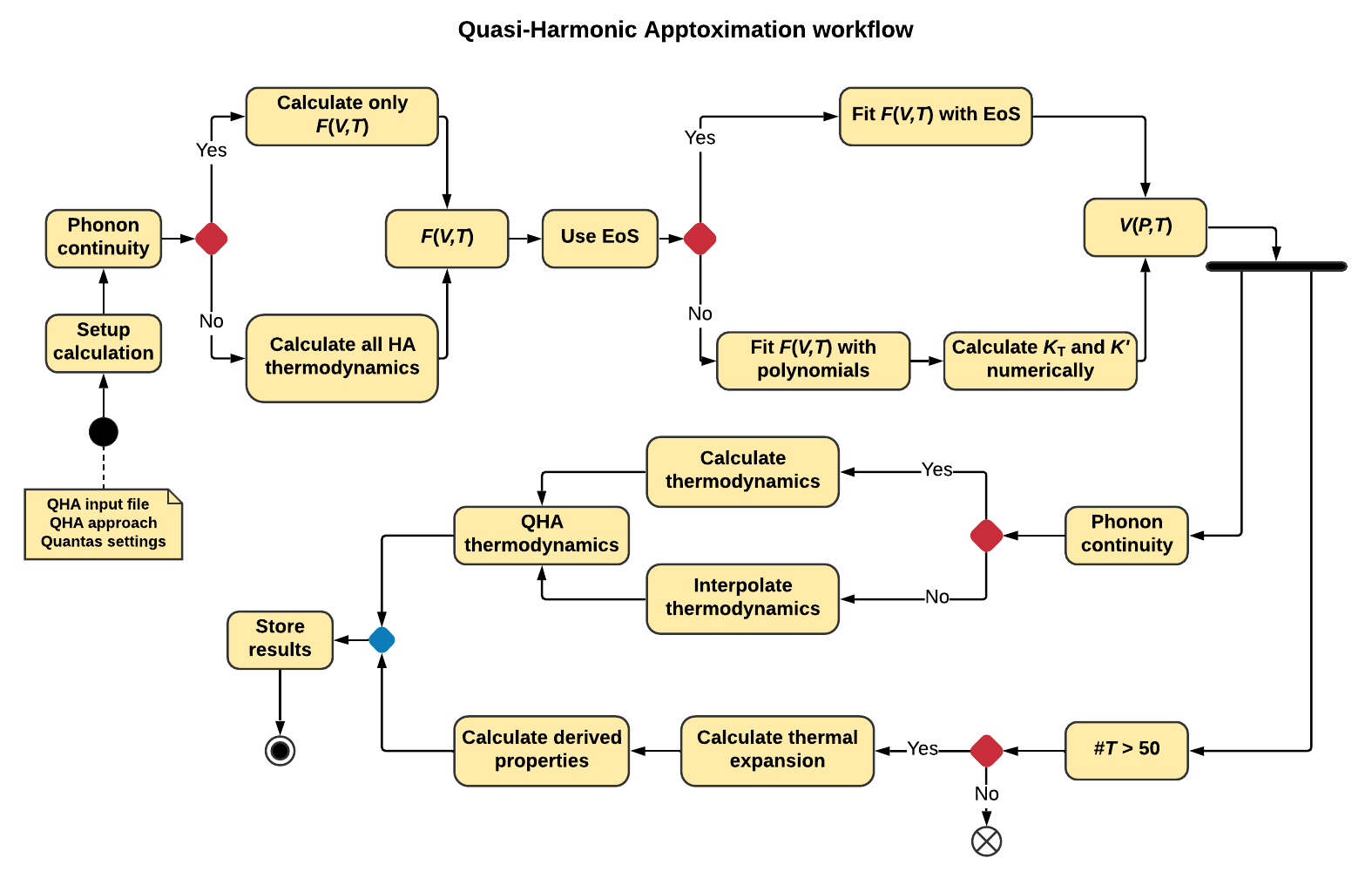
The following picture briefly shows how quasi-harmonic properties are calculated by Quantas. Two key points of the QHA approach are worth to be considered:
the treatment of the dependence of the phonon frequencies as a function of the unit cell volume \(\nu(V)\), which in Quantas can be considered by:
interpolation of the \(\nu(V)\) curves, or
interpolation of harmonic thermodynamic properties
where in both interpolation schemes polynomial functions are employed;
the minimization of the \(F(V,T)\), namely finding the unit cell volume at selected temperature and pressure conditions. This can be achieved:
numerically, by fitting the \(F(V,T)\) data with polynomial functions, or
phenomenologically, by fitting the same data using volume-integrated equation of state formulations.
References
- 1
Ulian, G., Valdre, G., 2015. Density functional investigation of the thermo-physical and thermo-chemical properties of 2M(1) muscovite. Am. Miner. 100, 935-944.
- 2
Anderson, O.L., 1995. Equation of state of solids for geophysics and ceramic science. Oxford University Press, New York, US.
- 3
Erba, A., 2014. On combining temperature and pressure effects on structural properties of crystals with standard ab initio techniques. J. Chem. Phys. 141.